


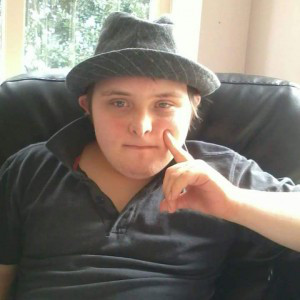
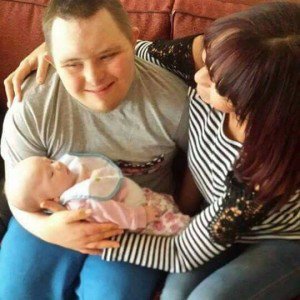



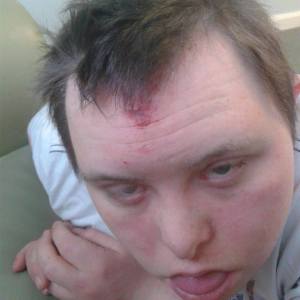
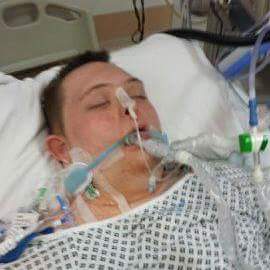
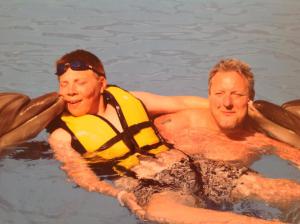
 Jack was born with ATRX syndrome, which on its own has its difficulties. He attended a special school and had no issues there at all until it was time to leave at 16.
 I had asked for an autism assessment since Jack left school, but it fell on deaf ears.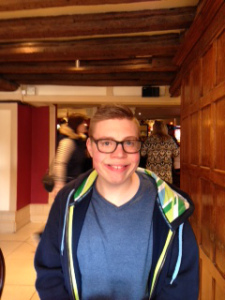
 The hospital are now trying to undermine our experience of Jack. We dont get any problems when Jack comes home on leave, although he gets very anxious prior to a home visit in case they cancel it. A couple of weeks ago, they cancelled Jack’s weekend home and Jack cleaned the whole ward in an attempt to get them to change their mind. Unfortunately, the Unit are now saying they don’t believe our reports of Jack’s behaviour at home. I know from other families that this is a familiar tactic to discredit families, it still feels very threatening for Jack’s future.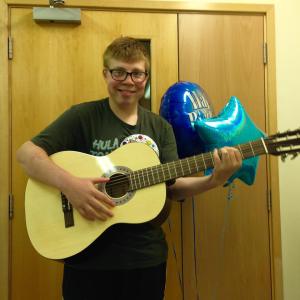
 The first post tells the story of Eden Norris. We chose this story to begin the seven days of action because Eden has been in ATUs for the last seven years of his life. This is way beyond the national average for time spent in ATUs.
 When Eden first moved to the current unit, staff communicated with him via a hatch. This was because of information passed on by the psychiatrist at the previous unit. Soon after, the current unit realised how wrong and misleading this information had been about Eden. And one of the staff said ‘he shouldn’t be here’.
 His medication had been reduced to 200 mg of Clopixol per week, but it has been put up to 300 mg per week. (Note: Clopixol is an antipsychotic but Eden does not have a psychotic disorder). Eden told his mum that his medication had gone up, the unit didn’t inform her about this. Being on less medication meant Eden was talking more. His family fear his medication has been put up to try and keep Eden quiet.

By Rob Greig
The Justice for LB campaign is widely, and rightly, viewed as one of the most successful examples of the mobilisation of public opinion to challenge service failure.
For those not familiar with it, Connor Sparrowhawk, a young man with learning disabilities, died while under the care of Southern Health NHS Foundation Trust in July 2013. Given the trust’s failure to accept responsibility, Connor’s family and friends launched the Justice for LB campaign (Laughing Boy, ‘LB’, was Connor’s nickname).
The trust initially said Connor died of ‘natural causes’ but an independent investigation found his death could have been prevented. Last year, an inquest jury found that neglect contributed to his death.
‘Failure of leadership’
Before Christmas, there was a sense that this campaign was leading to real change. Most notably, the findings were revealed from an NHS England-commissioned report (the Mazars review) into Southern Health’s handling of patient deaths.
The report described how the trust had, among other things, failed to investigate hundreds of unexpected deaths of people with learning disabilities or mental health conditions. It blamed a “failure of leadership” and warned investigators had “little confidence” the trust fully recognised the need to improve.
Strong words were said by people in authority. Health secretary Jeremy Hunt was “profoundly shocked” by the findings. Simon Stevens, NHS England’s chief executive, spoke of the health service being at a “cultural turning point” at which it must change the way it responds to families.
Lack of changes
However, since Christmas, far less has been said. It is also hard to identify any significant change to emerge from the litany of criticism that followed the Mazars report. What has happened to permit the silence that now surrounds this scandal?
Real change should be identifiable in three main places:
1) National policy: The reports and inquest provide learning about diverse issues. The rights of families. Staff training. How NHS trusts are allowed to merge and how their services are regulated. A new government ‘learning disability action plan’ is being developed. The version I’ve seen addresses none of the issues arising from Justice for LB.
2) General NHS practice and behaviour: One of the most disturbing statements in this saga came from Southern Health’s chief executive. She said that what was happening at Southern was no different to other NHS trusts.
A joint NHS England/CQC response to the Mazars review committed to action to find out if this is the case, but that involves a fair bit of shutting the stable door after the horse has bolted.
Improving investigation of deaths is good – but the key issue is stopping those deaths in the first place. That requires action around factors such as recognition of rights, family engagement, staff skills and applying real person-centred practice and leadership. The national action around this would be politely described as hard to see.
3) Southern Health: All the indications from Southern Health suggest they are still more concerned with denying responsibility than instigating fundamental change. The initial failure of the trust has been compounded by a persistent failure to accept responsibility. Accepting input from Monitor on how to improve death recording is not a cultural and quality improvement plan.
A fresh start is needed
Many observers remain baffled as to how the trust and NHS England cannot see the need for a fresh start to create that culture.
I’ve never been one to pillory individuals, but it took Connor’s young brother standing up in public to get Ms Percy to apologise directly to the family.
Effective leaders can see when they get things wrong – without needing a series of external reports to speak of ‘failure of leadership’. Out of self-respect, if nothing else, how can the chief executive and other leaders in the trust not accept their responsibility and recognise the need to move on?
Compare and contrast this with what happened after the Mid Staffordshire hospital scandal. There, neglect was considered to have caused fewer deaths than went uninvestigated in Southern. Yet senior people lost their jobs, staff were struck off their professional registers, families received compensation, a public inquiry was held and the government placed new, explicit expectations on the NHS, for example around staffing levels.
You cannot help but conclude that government is ascribing a different value to the lives of people with learning disabilities and older people with mental health problems (whose unexpected deaths also commonly went without investigation).
Why the lack of action?
In a recent blog, I described how, during my time as the government’s national director for learning disabilities, a very senior NHS manager said his non-delivery on institutional closure was acceptable because “no-one loses their job for not delivering on the learning disability agenda”. It is time to tell another anecdote.
Over 10 years ago, when the abuse of people with learning disabilities within NHS services in Cornwall was about to be exposed, I argued within the Department of Health (DH) for a robust action plan in response – if only because there would be a strong public demand for one.
A very senior DH official told me this wasn’t needed because “DH gets attacked in the media about the NHS every week. We take it on the chin, apologise for a couple of weeks, and then move on while the media forgets about it because it is attacking us about something else”.
Fortunately, he lost that argument and a task force was sent in to sort things out in Cornwall. However, that mentality remains in key places.
One of the strengths of the Justice for LB campaign is that the family, their friends and allies are not going to forget and move on. There is a need for government, NHS England and Southern Health to show that they have heard and acted on the need for real and discernible consequences and change – and demonstrate that Connor’s death, and those of others, has made a difference for other people with learning disabilities and their families.
Rob Greig is chief executive of the National Development Team for Inclusion. He was the Department of Health’s director for learning disabilities from 2001 to 2008.